Your inbox has become a battleground
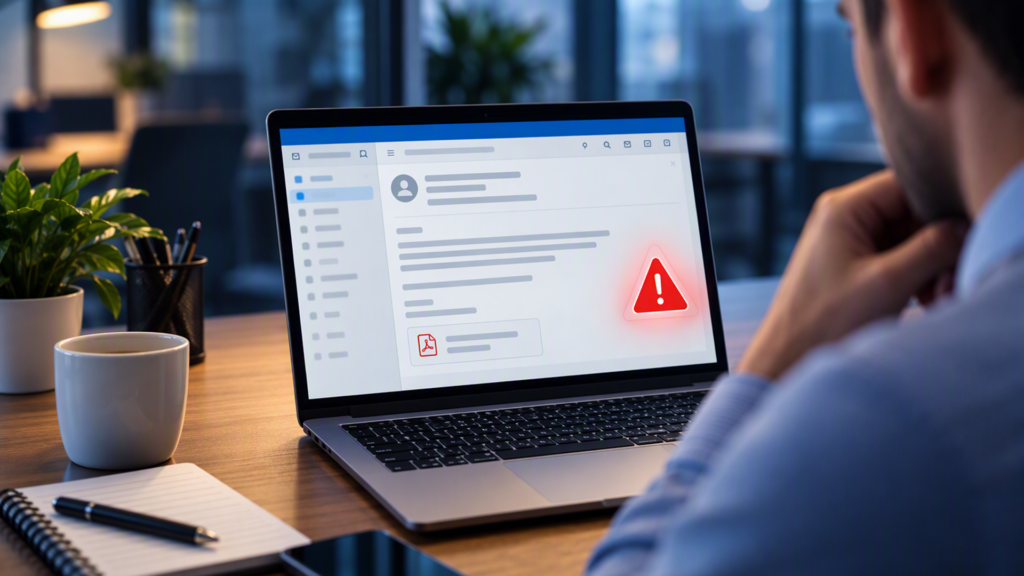
Most business owners and managers know that phishing emails exist. The problem is that the ones landing in inboxes today look nothing like the obvious scams of ten years ago. No broken English. No requests from foreign princes. Just a convincing email that looks exactly like it came from a colleague, a supplier, or your bank.
Business email fraud — often called business email compromise, or BEC — is one of the fastest-growing cyber threats facing small and medium-sized businesses in the UK right now. And it is working, not because businesses are careless, but because the attacks have become genuinely difficult to detect.
This article explains how it works, why it is harder to spot than ever, and what practical steps you can take to protect your business.
What is business email fraud?
Business email fraud is when a criminal impersonates a trusted person — often a senior member of staff, a supplier, or a client — to trick someone into taking an action. That action is usually one of three things: transferring money, sharing sensitive information, or clicking a link that installs malicious software.
The most common scenarios include:
- A fake email from the managing director asking the accounts team to make an urgent payment
- A supplier contact whose email account has been hijacked, sending revised bank details for a legitimate invoice
- A message appearing to come from a colleague, asking for login credentials or access to a shared document
In each case, the email looks plausible. It references real people, real relationships, and real contexts. That is precisely what makes it so dangerous.
Why it is getting harder to spot
Two things have changed significantly in recent years, and both are making business email fraud harder to identify.
Artificial intelligence is helping criminals write better emails
Fraudulent emails used to be relatively easy to spot because they were often poorly written. That is no longer a reliable indicator. Criminals are now using AI tools to generate polished, well-structured messages that mimic the tone and style of legitimate correspondence. An email purporting to come from your accountant or your IT provider can now be indistinguishable in quality from the real thing.
Criminals are doing their research
Before sending a single message, attackers often gather information about your business — from your website, LinkedIn profiles, Companies House, and social media. They learn the names of your directors, your suppliers, your clients, and your team. That information is then used to craft targeted emails that reference real people and real relationships, giving them an air of authenticity that generic phishing messages simply do not have.
This approach — sometimes called spear phishing — is particularly effective because it feels personal rather than random.
The real cost of getting it wrong
Business email fraud is not just a financial risk, although the financial consequences can be severe. A single successful attack can result in thousands of pounds transferred to criminals, with little prospect of recovery once the funds have moved.
Beyond the immediate loss, there is the disruption to your operations, the potential exposure of client data, and the reputational damage that follows. For businesses in professional services — law firms, accountancies, financial advisers — where client trust is everything, a security incident of this kind can have consequences that far outlast the initial event.
What your business can do right now
The good news is that most business email fraud can be prevented with a combination of the right technical controls and straightforward staff awareness. You do not need a large IT team or a complex security programme. You need a clear process and a team that knows what to look for.
Verify unusual requests before acting on them
If you receive an email requesting a payment, a change of bank details, or access to sensitive information — especially if it carries any sense of urgency — verify it through a separate channel before taking action. Pick up the phone and call the person directly using a number you already have. Do not use contact details from the email itself.
This single step prevents the majority of successful attacks.
Think carefully about what your out-of-office messages reveal
Out-of-office replies sent to people outside your organisation can inadvertently give criminals useful information — who is covering for you, which clients you are working with, when you will be back. For external recipients, a simple message confirming when you will reply and how to contact the business is all that is needed.
Use multi-factor authentication on all email accounts
Even if a criminal obtains a password — through a data breach or a phishing attempt — multi-factor authentication (MFA) makes it significantly harder for them to access the account. If your business uses Microsoft 365, MFA can be enabled across all user accounts and is one of the most effective security measures available to you at low cost.
Make security awareness part of everyday working
Technology alone cannot stop business email fraud. The most effective defence is a team that knows what to look for and feels confident enough to question something that does not seem right — even if it appears to come from a senior colleague. Regular, practical security awareness training makes a genuine difference. Not once-a-year presentations, but ongoing conversations that keep people alert.
Review who has access to financial systems and sensitive data
Limit the number of people who can authorise payments or access sensitive client information. Implement a two-person approval process for any financial transfers above a defined threshold. The fewer people who can act unilaterally, the less damage a single successful attack can cause.
Where to start if you are not sure
If you are uncertain how well protected your business currently is, the most useful first step is an honest review of your email security settings, your staff awareness, and your internal procedures for handling payment requests and sensitive data.
At Blisstech, we work with small and medium-sized businesses across the West Midlands to make sure their technology and their people are equipped to deal with threats like these. We explain everything in plain English, and we focus on practical steps that fit the way your business actually works.
If you would like to talk through your current setup and where the gaps might be, get in touch with our team. There is no obligation, and no jargon — just a straightforward conversation about keeping your business safe.